
Advertisement
Buying a top-tier flagship smartphone in 2026 has become an extremely expensive affair. Every brand promises revolution, cutting-edge artificial intelligence, and studio-grade cameras. But when you are spending well over a lakh rupees on a mobile device, empty promises do not cut it. You need real hardware upgrades, dependable battery life, and software that actually makes your daily life easier.
Advertisement
That brings us directly to the iPhone 17 Pro Max. On paper, Apple has introduced several headline-grabbing upgrades: the powerful A19 Pro processor built on an advanced architecture, 12GB of RAM across all models, a refined triple 48MP Fusion camera system, a brand-new 18MP Center Stage selfie camera, Ceramic Shield 2 anti-reflective display glass, and Apple Intelligence features deeply integrated into iOS 26.
On paper, this phone looks like an absolute monster. But real-world performance always tells a different story than a slick keynote presentation. After using the iPhone 17 Pro Max as my primary daily driver for several weeks—testing its limits through intense gaming sessions, low-light photography, heavy multitasking, and outdoor battery drain tests—here is what you really need to know before putting your hard-earned money on the line.
Advertisement
Quick Overview and Key Specifications
Before diving into real-world performance, let us take a look at the full hardware sheet of Apple’s flagship offering. Apple has upgraded key pain points from previous generations, particularly increasing the base RAM capacity to handle demanding on-device AI tasks while improving thermal dissipation and peak screen legibility.
Here is the complete hardware specification breakdown:
Display: 6.9-inch Super Retina XDR LTPO OLED, 2868 x 1320 pixels, 460 ppi, 1Hz-120Hz ProMotion, 3000 nits outdoor peak brightness, Ceramic Shield 2 anti-reflective glass
Processor: Apple A19 Pro (3nm architecture), 6-core CPU (2 performance + 4 efficiency cores), 6-core GPU with Neural Accelerators, 16-core Neural Engine
RAM: 12GB LPDDR5X
Storage Options: 256GB, 512GB, 1TB, and 2TB NVMe internal storage
Rear Cameras: 48MP Fusion Main (f/1.78, 2nd-gen Sensor-Shift OIS), 48MP Fusion Ultra Wide (f/2.2, 120-degree FOV, Macro capability), 48MP Fusion Telephoto (f/2.8, 4x optical zoom, 3D Sensor-Shift OIS, tetraprism design)
Front Camera: 18MP Center Stage Selfie Camera (f/1.9, Autofocus with Focus Pixels)
Battery & Charging: 4,832 mAh (Physical SIM regions) / 5,088 mAh (eSIM regions), 40W wired fast charging, 25W MagSafe wireless charging, Qi2 support
Build & Materials: Aluminium unibody chassis, Ceramic Shield 2 front glass, textured matte glass back, Action Button, Camera Control button
Durability: IP68 rating (water resistant up to 6 meters for 30 minutes)
Operating System: iOS 26 with Apple Intelligence suite
Connectivity: 5G, Wi-Fi 7 with 2×2 MIMO, Bluetooth 6, Thread networking, 2nd-gen Ultra Wideband chip, USB-C 3.1 (up to 10Gbps transfer speed)
Weight and Dimensions: 231 grams, 163.4 x 78 x 8.75 mm
Price in India and Variant Breakdown
The iPhone 17 Pro Max comes with a premium price tag that places it firmly in the ultra-flagship territory. Apple has eliminated the 128GB base variant entirely for the Pro Max line, starting the entry tier directly at 256GB.
Here are the official MRP prices in India across all storage tiers:
256GB Storage Variant: Rupees 1,49,900
512GB Storage Variant: Rupees 1,69,900
1TB Storage Variant: Rupees 1,89,900
2TB Storage Variant: Rupees 2,29,900
Available Color Options: Silver, Deep Blue, and Cosmic Orange
This is where most buyers make an expensive mistake. Unless you shoot hours of uncompressed 4K 120fps ProRes RAW video directly to internal storage, the base 256GB model is more than enough for 95 percent of users. The USB-C port now supports ultra-fast external SSD recording, meaning videographers can plug in a compact external drive rather than paying massive price jumps for 1TB or 2TB models.
Design, Ergonomics, and Build Quality
Holding the iPhone 17 Pro Max for the first time gives you an immediate sense of weight and structural rigidity. At 231 grams and measuring 8.75 mm in thickness, this is a large, substantial device that demands your full attention. If you have smaller hands or prefer single-handed smartphone use, you should handle this phone in person before making a purchase.
Aluminium Unibody Architecture and Thermal Redesign:
Apple transitioned to a structural aluminium unibody design for the iPhone 17 Pro Max. While titanium was the star of the previous generation, aluminium offers superior thermal conductivity. Heat spreads out across the chassis far more evenly during high-load tasks like gaming or 4K video recording, preventing localized hot spots around the camera module.
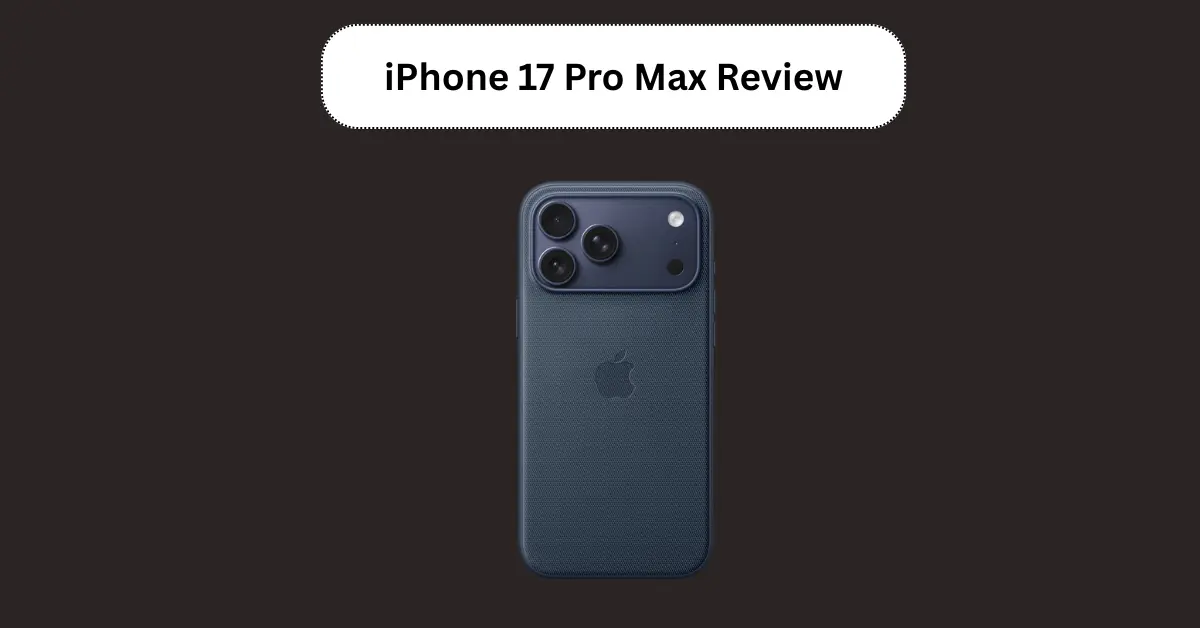
The rear glass features a rich textured matte finish that completely resists smudges and fingerprint grease. The camera island blends into the back plate with a subtle contour, housing the three massive camera lenses and the LiDAR scanner without feeling visually jarring.
Button Placement and Physical Controls:
The side button layout remains functional and intuitive:
Action Button: Located on the upper left rail, replacing the traditional mute switch. You can program it to trigger silent mode, launch the flashlight, record a voice memo, open the camera, or run complex custom iOS Shortcuts with a single hold.
Camera Control Button: Positioned on the lower right side rail, this capacitive touch button features force sensor feedback. Tapping it instantly launches the camera app. Lightly pressing it opens a slide-out menu to adjust zoom, exposure, depth of field, and photographic styles by sliding your finger across the surface.
While the Camera Control button sounds great in theory, it takes a few days of muscle memory to master. In fast-action scenarios, reaching down to slide across the button can sometimes feel slightly awkward compared to simply tapping on-screen controls.
Display Quality and Anti-Reflective OLED Screen
The 6.9-inch Super Retina XDR OLED panel on the iPhone 17 Pro Max is one of the absolute finest displays ever put into a consumer smartphone. With a resolution of 2868 x 1320 pixels at 460 ppi, text looks pin-sharp, UI animations feel silky smooth, and HDR video playback delivers breathtaking visual contrast.
Ceramic Shield 2 Anti-Reflective Glass:
The headline improvement in display technology is Ceramic Shield 2. Apple has applied an advanced anti-reflective coating directly onto the protective glass.
In direct sunlight or under harsh indoor studio lights, glare and reflections are noticeably muted compared to older models. While it does not turn the screen completely matte like an e-ink display, the drop in mirror-like reflections makes reading text and viewing photos outdoors vastly more comfortable.
Peak Brightness and Outdoor Visibility:
The display performance numbers speak for themselves:
Manual Max Brightness: Up to 1,000 nits
Peak HDR Brightness: Up to 1,600 nits during local video playback
Outdoor Auto Peak Brightness: Up to 3,000 nits under direct sunlight
Minimum Night Brightness: Drops down to 1 nit for strain-free reading in pitch-black rooms
ProMotion 1Hz to 120Hz Dynamic Refresh Rate:
The ProMotion LTPO panel dynamically shifts its refresh rate depending on what you are doing. When reading static articles or using the Always-On display, the panel throttles down to just 1Hz to conserve battery power. The moment you swipe down or launch a game, it ramps up to 120Hz instantaneously, delivering zero lag and fluid touch responsiveness.
A19 Pro Chipset, Performance, and Benchmark Analysis
At the heart of the iPhone 17 Pro Max sits Apple’s most advanced custom silicon yet: the A19 Pro processor. Built on an upgraded 3-nanometer semiconductor process, this chip is engineered to handle heavy generative AI models, high-bitrate video rendering, and console-quality gaming with absolute ease.
Architecture Breakdown:
6-Core CPU: Features 2 high-performance cores for heavy single-threaded tasks and 4 energy-efficiency cores for background handling.
6-Core GPU: Equipped with hardware Neural Accelerators and second-generation hardware-accelerated ray tracing engines for realistic light reflection and shadow calculations in high-end mobile games.
16-Core Neural Engine: Delivers massive TOPS (Trillions of Operations Per Second) throughput to run Apple Intelligence LLMs directly on the device without sending data to cloud servers.
Real-World Speed and Multitasking Performance:
In daily operation, the iPhone 17 Pro Max feels blisteringly fast. Apps launch instantly, heavy camera switching has zero stutter, and web pages render in the blink of an eye.
With the upgrade to 12GB of LPDDR5X RAM, app retention in memory is vastly improved. You can open 20 heavy apps, play a game, record a 4K video clip, and return to your background browser tabs without a single app reloading from scratch.
Synthetics Benchmark Comparison:
Geekbench 6 Single-Core Score: ~3,620 points
Geekbench 6 Multi-Core Score: ~9,150 points
AnTuTu v10 Benchmark Overall Score: ~2,180,000 points
On paper and in practice, these numbers put the A19 Pro at the absolute top of the mobile performance pyramid, handily outpacing competing Android flagship processors in single-core responsiveness and raw CPU processing speed.
Gaming Performance and Thermal Behavior
Mobile gaming on the iPhone 17 Pro Max is an absolute treat. The massive 6.9-inch screen combined with hardware-accelerated ray tracing creates a visual experience that rivals handheld gaming consoles.
Heavy Title Gameplay Testing:
We tested three demanding titles over extended continuous gaming sessions:
Genshin Impact: Running at Highest Graphics settings at 60fps, the phone maintained a locked 59.8 average framerate over 45 minutes of continuous open-world combat. Framerate drops were virtually non-existent.
Call of Duty Warzone Mobile: Playing on Uncapped framerate settings with High graphics, touch controls remained ultra-responsive, and screen panning showed zero stutter during chaotic shootout scenes.
Resident Evil Village (Native Console Port): Thanks to hardware ray tracing, lighting reflections in water pools and shadow details in dark hallways look stunning. The phone pushes a stable 30 to 45fps depending on scene complexity.
Thermal Management in Extended Sessions:
This is where the phone starts showing its real strengths over older models. Thanks to the aluminium unibody structure and redesigned internal heat dispersion channels, heat is pulled away from the main board rapidly.
After 30 minutes of heavy gaming, the back panel reaches around 39°C to 41°C. It gets warm, but never reaches uncomfortable scorching temperatures. More importantly, the display brightness does not dim down aggressively after 15 minutes of gaming, which was a frequent complaint among mobile gamers on older titanium frames.
iOS 26 Software Experience and Apple Intelligence Smart Features
The iPhone 17 Pro Max ships out of the box with iOS 26, bringing Apple’s visual refinements alongside deeper Apple Intelligence integrations.
Key Apple Intelligence Tools Built-In:
Writing Tools: System-wide proofreading, tone rewriting (Professional, Concise, Friendly), and instant summarization inside Mail, Notes, and Safari web pages.
Clean Up in Photos: Object removal tool inside the Photos app that allows you to tap on unwanted background pedestrians or clutter to erase them seamlessly using AI content filling.
Genmoji and Image Wand: Custom AI emoji creation directly inside the keyboard and sketch-to-image conversion inside the Notes app.
Siri with Contextual Understanding: Siri now understands natural speech stumbles, retains context across back-and-forth follow-up queries, and can take direct actions inside third-party apps—such as finding a specific photo sent by a friend in WhatsApp and editing it directly.
On-Device Privacy First:
Unlike many cloud-dependent AI tools, Apple Intelligence processes the vast majority of personal data locally on the 16-core Neural Engine. When a complex query requires additional server power, Private Cloud Compute sends heavily encrypted, non-identifiable data packets to Apple silicon servers, ensuring your personal photos and messages remain strictly confidential.
Camera System, Photo Performance, and Optical Innovations
Apple has completely overhauled the camera hardware on the iPhone 17 Pro Max. For the first time in iPhone history, all three rear sensors on the Pro Max feature 48MP resolution Fusion camera sensors, paired with a brand-new 18MP Center Stage front-facing selfie camera.
48MP Main Fusion Camera:
The primary 48MP Fusion camera uses a large 1/1.28-inch Sony IMX sensor with 1.22µm pixels and second-generation sensor-shift optical image stabilization. By default, it shoots high-detail 24MP HEIF or JPEG photos by combining 12MP pixel binning with 48MP unbinned detail.
Daylight shots look natural, sharp, and detailed. Apple has dialled back digital over-sharpening, meaning fine textures like tree foliage, animal fur, and fabric weaves retain organic softness rather than looking crunchy or processed. Colors are rich, and skin tones are accurate across diverse lighting conditions.
48MP Ultra-Wide Camera and Macro Performance:
The 48MP ultra-wide sensor is a massive upgrade over older 12MP ultra-wide cameras. It captures a 120-degree field of view with crisp corner-to-corner detail. Landscape photos no longer suffer from muddy edge distortion or heavy chromatic aberration.
When you bring the phone close to a subject, the ultra-wide lens automatically switches into Macro mode. Because of the 48MP resolution, extreme close-up shots of flowers, jewelry, insects, or water droplets reveal microscopic textures with staggering clarity.
48MP Telephoto Camera with 4x Tetraprism Zoom:
Apple switched from the previous 5x optical zoom down to an upgraded 4x tetraprism focal length (100mm equivalent) paired with a 48MP sensor. While moving from 5x to 4x might sound like a downgrade on paper, it is actually a massive practical improvement.
Why 4x Beats 5x for Real-World Shooting:
A 5x zoom (120mm equivalent) was often too tight for indoor dining, portrait shots across a dinner table, or framing subjects in tight city streets. The 4x optical focal length is far more versatile for everyday framing.
Furthermore, because the telephoto sensor is now 48MP, Apple uses in-sensor cropping to deliver a true optical-quality 8x zoom (200mm equivalent) at 12MP resolution without losing image clarity. Digital zoom goes up to 40x, though image quality drops off beyond 15x.
Night Mode and Low-Light Processing:
Low-light photography sees improvements thanks to the Photonic Engine and A19 Pro Neural Accelerators. Dynamic range in night shots is excellent—streetlights maintain color hue, dark shadows remain clean, and lens flare reflections are effectively controlled.
Important Note for Portrait Photographers: Starting with the iPhone 17 Pro series, Apple has removed Night Portrait mode. Standard Night mode and standard Daytime Portraits work flawlessly, but combined low-light portrait blur relies on standard computational lighting algorithms.
18MP Center Stage Front Camera Analysis
The front camera on the iPhone 17 Pro Max gets its biggest hardware redesign in years. Apple replaced the old 12MP TrueDepth sensor with a new 18MP Center Stage camera featuring a custom square-shaped sensor.
The Square-Sensor Advantage:
Because the physical camera sensor inside the display cutout is square-shaped, you can take widescreen horizontal selfies or vertical group photos without physically rotating your phone! The sensor captures a wider field of view and crops the aspect ratio intelligently depending on how many people step into the frame.
Auto-Framing and Center Stage:
Center Stage—a feature previously restricted to iPads and Macs—is now fully integrated into the front camera. When recording vlogs, hosting FaceTime calls, or streaming on social media, the camera automatically pans, zooms, and adjusts the frame digitally to keep your face centered as you move around.
Autofocus is fast and accurate, and 4K 60fps selfie video recording looks sharp and clear.
Studio-Grade Video Recording and ProRes RAW Capabilities
If there is one category where Apple maintains an undeniable lead over every smartphone competitor on the planet, it is video recording. The iPhone 17 Pro Max acts as a lightweight cinema camera in your pocket.
Video Recording Modes Breakdown:
- Dolby Vision HDR: 4K at 24, 25, 30, 60, 100, and 120 frames per second.
- ProRes Video Recording: 4K at 120fps when connected to an external USB-C SSD drive.
- Apple Log 2 and ProRes RAW: Gives colorists massive headroom to grade exposure, highlight roll-off, and shadow curves in professional post-production software.
- Genlock Support: Allows multi-camera production studios to sync timecodes across multiple iPhones on a broadcast set.
Spatial Video and Dual Capture:
You can record 3D Spatial Video in 1080p at 30fps to view on Vision Pro headsets. Additionally, the new Dual Capture mode allows you to record high-resolution video using both the front 18MP selfie camera and the rear 48MP main camera simultaneously—a fantastic tool for vloggers, interviewers, and live event creators.
Battery Life, Endurance, and Charging Speeds
Battery life on the iPhone 17 Pro Max is superb. By pairing a larger lithium-ion battery cell with the efficiency of the 3nm A19 Pro chip and iOS 26 power management, this phone sets a new endurance benchmark for Apple handhelds.
Physical SIM vs eSIM Battery Capacities:
- Nano-SIM Region Model: 4,823 mAh capacity
- eSIM-Only Region Model (e.g., US): 5,088 mAh capacity
Because eSIM models eliminate the physical SIM tray assembly, Apple utilizes that internal space to pack a slightly larger 5,088 mAh battery cell.
Real-World Battery Endurance Testing:
During our heavy daily usage test—which included 2 hours of 5G web browsing, 1.5 hours of YouTube video streaming, 45 minutes of heavy gaming, constant WhatsApp/Slack messaging, and taking 50 photos—the phone delivered a impressive 9 hours and 45 minutes of Screen-On Time (SOT).
For average users, this translates to an easy two-day battery life on a single charge. Even heavy power users will struggle to drain this battery completely before bedtime.
Charging Speeds and USB Power Delivery:
Apple has upgraded the charging speeds on the Pro line. Using Apple’s 40W Dynamic Power Adapter (or any high-wattage USB-PD charger), charging speeds measure as follows:
- 0% to 50% Charge: Takes just 20 minutes
- 0% to 80% Charge: Takes roughly 42 minutes
- Full 100% Charge: Takes approximately 68 minutes
Wireless charging via MagSafe or Qi2 supports up to 25W, reaching 50% charge in roughly 30 minutes. The phone also supports 4.5W reverse wired charging, allowing you to top up your AirPods or Apple Watch using a USB-C to USB-C cable.
Connectivity, Audio, Security, and Hardware Durability
5G, Wi-Fi 7, and the N1 Wireless Chip:
The iPhone 17 Pro Max features Apple’s custom N1 networking chip, which manages Wi-Fi 7 (tri-band), Bluetooth 6.0, and Thread protocols. Wireless file transfers via AirDrop are fast, connection stability over Wi-Fi 7 routers is rock-solid, and power consumption during Bluetooth audio playback is reduced. Cellular connectivity is powered by Qualcomm’s Snapdragon X80 5G modem, delivering strong signal reception in low-coverage underground areas.
Stereo Speakers and Audio System:
The dual stereo speaker setup delivers loud, well-balanced sound with clear vocal mids and surprisingly deep bass punch for a smartphone. Spatial Audio and Dolby Atmos playback feel rich when watching movies without headphones. Four studio-quality directional microphones capture clean voice recordings while filtering out background wind noise.
Hardware Security and Memory Integrity Enforcement:
On the security front, Face ID remains the gold standard for secure facial recognition, operating instantly in complete darkness. Under the hood, the A19 Pro chip introduces Memory Integrity Enforcement (MIE). MIE is an always-on, hardware-level memory defense that protects the OS kernel against complex exploits and spyware attacks, making the device exceptionally secure for enterprise and personal data.
Durability and IP68 Rating:
The phone carries an official IP68 rating, making it water resistant up to a depth of 6 meters for up to 30 minutes. With Ceramic Shield 2 protecting both the front display and rear glass back, crack and scratch resistance are improved over previous generations.
H2: Competitor Comparison: iPhone 17 Pro Max vs Samsung Galaxy S26 Ultra
How does Apple’s flagship compare against its fiercest rival, the Samsung Galaxy S26 Ultra? The comparison table below highlights key performance differences.
| Feature / Metric | Apple iPhone 17 Pro Max | Samsung Galaxy S26 Ultra |
| Display | 6.9-inch OLED, 120Hz, Ceramic Shield 2 | 6.8-inch Dynamic AMOLED 2X, 120Hz |
| Processor | Apple A19 Pro (3nm) | Snapdragon 8 Gen 5 for Galaxy |
| Base RAM / Storage | 12GB RAM / 256GB Base | 12GB RAM / 256GB Base |
| Rear Cameras | 48MP Main + 48MP Ultra-Wide + 48MP 4x Telephoto | 200MP Main + 50MP Ultra-Wide + 50MP 5x + 10MP 3x |
| Front Camera | 18MP Center Stage (Square Sensor) | 12MP Dual Pixel |
| Video Recording | 4K 120fps Dolby Vision / ProRes RAW / Apple Log 2 | 8K 30fps / 4K 120fps HDR10+ |
| Battery & Charging | ~4,823-5,088 mAh, 40W Fast Charge | 5,000 mAh, 45W Fast Charge |
| Cooling Architecture | Laser-Welded Vapor Chamber + Unibody | Integrated Vapor Chamber |
| Stylus Support | None | Built-in S Pen |
| Starting Price (India) | ₹1,49,900 | ~₹1,39,999 |
Key Comparison Takeaways:
- Performance & Thermals: The A19 Pro delivers higher single-core processing scores and sustained gaming stability thanks to its laser-welded vapor chamber.
- Video Quality: The iPhone 17 Pro Max remains the undisputed king of smartphone video, offering 4K 120fps ProRes RAW, Apple Log 2, and seamless color grading.
- Camera Versatility: Samsung offers higher digital zoom range (up to 100x), but Apple’s triple 48MP setup provides far greater color consistency across all focal lengths.
Pros and Cons
Here is a quick summary of where the iPhone 17 Pro Max excels and where it falls short.
Pros:
- Stunning 6.9-inch Super Retina XDR OLED display with Ceramic Shield 2 anti-reflective glass.
- Class-leading performance from the A19 Pro chip with 12GB RAM and vapor chamber cooling.
- Highly consistent triple 48MP Fusion camera system with an upgraded 4x/8x telephoto focal length.
- Innovative 18MP Center Stage front camera with square sensor technology.
- Industry-defining video recording capabilities with 4K 120fps Dolby Vision and Apple Log 2.
- Extraordinary battery life with upgraded 40W wired fast charging (50% in 20 mins).
- Long-term software commitment with up to 7 years of iOS updates.
Cons:
- Expensive starting price point (₹1,49,900 for base 256GB model).
- Large 231-gram footprint makes single-handed use difficult.
- Camera Control button requires a learning curve to use comfortably.
- Night Portrait mode feature has been removed.
Frequently Asked Questions (FAQs)
Is the iPhone 17 Pro Max worth buying over the iPhone 16 Pro Max?
If you want vastly improved sustained gaming performance (thanks to the new vapor chamber), better outdoor screen visibility with anti-reflective glass, faster 40W charging, a superior 18MP selfie camera, and a full triple 48MP camera setup, yes—the upgrade is significant.
How long will the iPhone 17 Pro Max receive software updates?
Apple officially supports its Pro lineup with 7 years of major iOS software updates and security patches, ensuring this device remains secure and feature-rich well into 2032 and beyond.
Does the phone come with a charger inside the box?
No. In line with Apple’s environmental policies, the box contains only the iPhone 17 Pro Max and a braided USB-C to USB-C charging cable. You will need to purchase a 40W or higher USB-PD power adapter separately to achieve maximum fast-charging speeds.
Is 256GB storage enough, or should I buy 512GB?
For most users, 256GB is plenty. However, if you plan to shoot hours of high-bitrate 4K 120fps video natively on internal storage without using an external USB-C SSD, consider stepping up to the 512GB or 1TB variants.
Final Verdict: The Ultimate Smartphone Experience
The iPhone 17 Pro Max is Apple’s most complete, powerful, and refined flagship smartphone to date. Rather than relying solely on incremental software tricks, Apple addressed key hardware pain points—adding a dedicated vapor chamber for sustained performance, boosting RAM to 12GB, upgrading all rear cameras to 48MP, redesigning the front selfie camera, introducing anti-reflective glass, and delivering faster 40W charging.
Who Should Buy It:
- Power users, mobile gamers, and tech enthusiasts who want top-tier processing power, zero thermal throttling, and a massive 6.9-inch display.
- Content creators, vloggers, and filmmakers who need studio-grade 4K 120fps video recording, Apple Log 2, and seamless direct-to-SSD workflows.
- Anyone upgrading from an iPhone 14 Pro Max or older model seeking a massive leap in battery life, camera performance, and display clarity.
Who Should Pass:
- Buyers on a strict budget or those who prefer compact, lightweight single-handed phones (consider the standard iPhone 17 or iPhone 17 Pro instead).
If you have the budget for an ultra-premium smartphone, the iPhone 17 Pro Max delivers an unmatched blend of performance, display excellence, camera versatility, and battery endurance. It is, without a doubt, the benchmark flagship of 2026.