
Advertisement
If you are planning to upgrade your content creation setup or buy your very first dedicated video camera, here is what you need to know. The handheld camera market has seen wild transformations over the last few years. Mobile phones now feature massive sensors, action cameras have become indestructible, and mirrorless setups offer cinema-grade depth. Yet, every single time a solo creator steps outside to film a travel vlog, record an interview, or capture cinematic B-roll, they are forced to make a compromise. Smartphones overheat and lack real mechanical stabilization. Action cameras struggle in low light. Mirrorless cameras require heavy gimbals, huge lenses, and constant rebalancing.
Advertisement
That is precisely why the Pocket series became an absolute phenomenon. When the previous generation launched, it virtually dominated the vlogging space. Now, with the release of the DJI Osmo Pocket 4p, expectations are ridiculously high. On paper, this pocket gimbal camera looks incredible. It promises a refined 1-inch CMOS sensor, 4K video recording at a staggering 240 frames per second, 14 stops of dynamic range, 10-bit D-Log color profiles, built-in storage, and upgraded ActiveTrack 7.0 tracking algorithms.
But real-world performance always tells a different story than a marketing spec sheet. Does the DJI Osmo Pocket 4p fix the thermal bottlenecks, audio quirks, and optical limitations of its predecessor? Is it worth spending your hard-earned money on this device, or should you stick with a high-end smartphone or action camera? After using this camera across various environments—from bright sunlight on busy city streets to dim low-light indoor shoots—here is our definitive, deep-dive review.
Advertisement
Quick Overview and Key Specifications
Before diving into the real-world performance, let us examine the core technical foundation of the DJI Osmo Pocket 4p. DJI has reworked several internal components, giving creators higher frame rates, better dynamic range, dedicated zoom capabilities, and built-in flash storage so you never get caught without a microSD card on location.
Here is the complete hardware breakdown:
Sensor Size: 1-inch CMOS Sensor
Lens Aperture: f/2.0
Equivalent Focal Length: 20mm wide-angle equivalent
Video Resolution: 4K up to 60fps standard, 4K up to 240fps slow motion
Max Dynamic Range: 14 Stops
Color Profiles: 8-bit Normal, 10-bit HLG, 10-bit D-Log
Photo Resolution: Up to 37 Megapixels
Zoom Capability: 2x Lossless Zoom (up to 4x digital zoom)
Display: 2.0-inch OLED Rotatable Touchscreen, 1000 nits peak brightness
Built-in Internal Storage: 107 GB high-speed internal flash storage
External Storage Support: MicroSD card slot supporting up to 1 TB (U3 / V30 / A2 rated)
Stabilization: 3-Axis Mechanical Gimbal with plus-minus 0.005 degree accuracy
Tracking System: ActiveTrack 7.0 with Intelligent Subject Focus and Face Priority
Audio System: 3-Microphone Array with OsmoAudio 4-Channel Recording and direct DJI Mic integration
Battery Capacity: Integrated high-density lithium-ion battery with fast charging
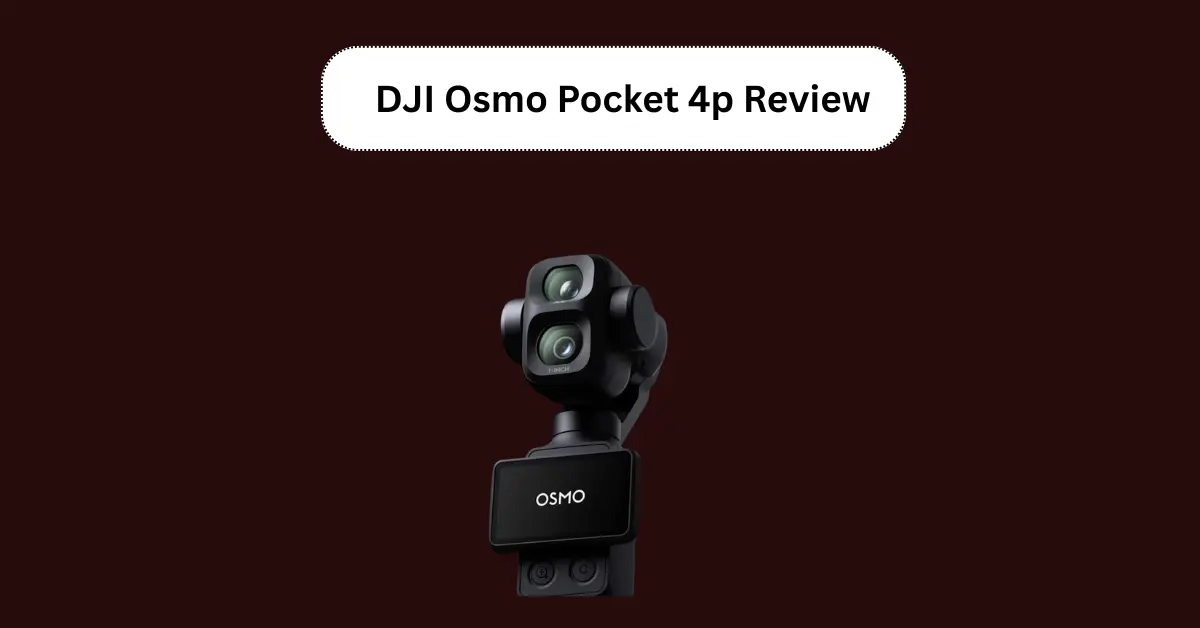
Dimensions: 144.2 x 44.4 x 33.5 mm
Weight: 190.5 grams
Connectivity: USB 3.1 Type-C (up to 800 MB/s transfer speed), Wi-Fi 6, Bluetooth 5.2
Price Variants and What Is in the Box
DJI offers the Osmo Pocket 4p in two primary configurations, depending on your workflow and whether you already own dedicated wireless audio gear.
Standard Combo:
This base package includes the DJI Osmo Pocket 4p unit, a protective gimbal clamp cover, a wrist strap, a bottom handle extension with a standard 1/4-inch tripod thread, a USB-C to USB-C 3.1 charging cable, and a lightweight protective pouch. It is aimed at creators who already own wireless microphones or intend to use the camera purely as a portable secondary B-cam.
Creator Combo:
This is the ultimate package for solo vloggers, interviewers, and travel filmmakers. In addition to everything found in the Standard Combo, it adds the upgraded wireless transmitter system with magnetic mounting clips and windscreens, a clip-on wide-angle lens attachment, a magnetic fill light, a mini foldable tripod handle, and a custom multi-compartment carrying bag.
This is where most buyers make an expensive mistake. If you film yourself speaking outdoors or in noisy environments, buying the Standard Combo and purchasing separate wireless audio transmitters later will end up costing you significantly more money. The Creator Combo offers far superior overall value if audio quality is anywhere on your priority list.
Design, Ergonomics, and Build Quality
Holding the DJI Osmo Pocket 4p for the first time reveals just how much engineering effort went into refining its physical handling. The device weighs roughly 190.5 grams, making it light enough to slip into a jacket pocket or daily sling bag without feeling bulky. Yet, it feels remarkably dense, premium, and durable in the hand. The main chassis uses a matte textured composite material that offers decent grip while resisting fingerprint smudges and sweaty palm marks during long filming sessions.
The New Physical Layout and Dedicated Buttons:
One of the most immediate improvements you notice during daily operation is the revamped control layout. Previous generations relied almost entirely on touch navigation for mode switching and zoom adjustments. While touch controls look sleek, they can be frustrating when you are trying to capture fast action or operating the camera with gloved hands.
On the Pocket 4p, DJI has introduced physical controls that significantly speed up operation:
- 5D Joystick: Located right under your thumb, this tactile joystick gives you precise manual pan and tilt control. Pressing it once acts as a back button, pressing it twice instantly recenters the gimbal, and pressing it three times flips the camera 180 degrees into selfie mode.
- Dedicated Zoom Button: A single press instantly toggles between 1x focal length and 2x lossless crop mode. Double tapping jumps straight to 4x zoom. This makes framing adjustments effortless without hunting through screen menus.
- Customizable Function Button: You can program this button to lock exposure, toggle color profiles, or trigger custom shooting presets instantly.
The 2-Inch Rotatable Touchscreen:
The crown jewel of the hardware design remains the rotatable 2-inch OLED display. Turning the screen 90 degrees acts as the primary physical power switch. Rotate the screen horizontally, and the camera boots up in under two seconds, centering its mechanical gimbal and locking onto your scene before you even have time to adjust your grip. Rotating it back to vertical either shuts the unit down or switches recording into native 9:16 vertical mode for social media platforms like Instagram Reels and YouTube Shorts.
The screen itself reaches a peak brightness of 1000 nits. Even under direct afternoon sunlight, framing your shots and reviewing footage is completely effortless. Colors are punchy, touch response is instantaneous, and the haptic feedback engine provides clear tactile ticks when navigating menus or selecting tracking targets.
Camera Sensor and Optical Hardware Analysis
At the core of any video camera is its glass and silicon. The DJI Osmo Pocket 4p utilizes a customized 1-inch CMOS sensor paired with an f/2.0 fixed aperture lens, offering a 20mm-equivalent wide-field perspective.
Why the 1-Inch Sensor Matters:
For years, smartphone manufacturers have claimed that software computational photography can replace physical sensor size. But when it comes to raw motion video recording, algorithmic tricks fall short. Standard action cameras and typical smartphone lenses utilize small 1/1.3-inch or smaller sensors. These small chips create harsh video noise in shadows and compress dynamic range, leading to blown-out skies and crushed shadow details.
The massive 1-inch sensor in the Osmo Pocket 4p gathers substantially more light per pixel. This results in three immediate visual benefits:
- Natural Optical Bokeh: Because of the large physical sensor size and bright f/2.0 aperture, background separation happens naturally at close-to-medium distances. Subject isolation looks soft, cinematic, and optical—not like the artificial blurred background effects produced by smartphone portrait modes.
- Clean Shadow Detail: When shooting in high-contrast environments or dark interiors, shadow regions maintain clean detail without the grainy digital noise that plagues smaller cameras.
- Broader Dynamic Headroom: Bright highlights like streetlights, midday clouds, or reflective water surfaces retain color hue and smooth roll-off instead of clipping directly to pure blown-out white.
Lens Optics and Lossless Zoom Architecture:
The 20mm focal length strikes a brilliant balance for handheld creation. It is wide enough to capture your face and background scenery simultaneously when holding the camera at arm’s length, without introducing severe fisheye distortion along the edges of the frame.
When you need tighter framing, the new 2x lossless zoom mode utilizes sensor cropping on the high-resolution 37-megapixel sensor. Unlike standard digital zoom that simply blows up low-resolution pixels and degrades sharpness, the Osmo Pocket 4p retains crisp, true 4K resolution at 2x zoom. Switching back and forth between 1x and 2x feels like having two prime lenses built directly into your pocket.
Video Recording Capabilities and Image Processing
This is where the camera starts showing its real strengths. The image processing engine inside the Osmo Pocket 4p has received massive upgrades, enabling shooting modes that were previously impossible on a handheld device of this size.
4K at 240fps Slow-Motion Performance:
For creators who produce sports content, travel montages, or high-speed B-roll, the standout feature is the inclusion of 4K slow-motion recording at up to 240 frames per second.
Most consumer cameras force you to drop down to lower 1080p resolutions to shoot at high frame rates, resulting in soft, pixelated footage. The Osmo Pocket 4p captures buttery-smooth 8x slow-motion directly in 4K resolution. Motion playback is fluid, sharpness remains incredibly detailed, and the mechanical gimbal completely eliminates micro-jitter, making handheld slow-motion clips look like they were filmed on a professional cinema rig with a motorized track.
14-Stop Dynamic Range and 10-Bit Color Profiles:
If you like to color grade your footage in post-production software like DaVinci Resolve or Final Cut Pro, the Osmo Pocket 4p gives you tremendous flexibility. The sensor delivers a claimed 14 stops of dynamic range when shooting in 10-bit D-Log or HLG modes.
Here is how the color profiles break down during actual testing:
- 8-Bit Normal Profile: Perfect for creators who want fast turnaround. Colors are vibrant, skin tones are warm and accurate right out of the camera, and contrast is nicely balanced for direct uploading without editing.
- 10-Bit HLG (Hybrid Log-Gamma): Excellent for High Dynamic Range playback on modern OLED TVs and HDR displays. It captures wide contrast without requiring heavy manual color correction.
- 10-Bit D-Log: This is the profile that serious videographers will love. It flattens contrast and desaturates color values to preserve detail in bright highlights and deep shadows. During post-production grading, you can lift dark shadows, pull back bright skies, and apply custom color LUTs without the image breaking apart or showing color banding.
Low-Light and Night Shooting Performance:
Low-light performance has historically been the heel of small gimbal cameras. However, the combination of the 1-inch sensor, f/2.0 optical aperture, and upgraded noise-reduction algorithms allows the Pocket 4p to shoot cleanly in challenging environments.
When filming in dedicated Low-Light Mode, the camera raises its maximum ISO ceiling up to 25,000 while applying intelligent spatial noise reduction. City streetscapes at night retain rich color saturation in neon signs, while dark pavement remains clean without digital noise artifacts. While it will not match a full-frame mirrorless camera paired with a prime lens, it utterly outperforms any action camera on the market when the sun goes down.
Stabilization and Tracking Intelligence
A great camera sensor is completely useless if your video footage is unwatchably shaky. This is where the mechanical 3-axis gimbal completely outshines software-based electronic image stabilization (EIS) found on smartphones and action cameras.
3-Axis Mechanical Gimbal Mechanics:
Electronic stabilization on phones works by cropping into your video frame and digitally warping pixels to mask movement. This results in reduced sharpness, unnatural motion blur, and terrible performance in low-light conditions where software stabilization creates jarring motion artifacts.
The Osmo Pocket 4p uses physical brushless motors across three axes—Pan, Tilt, and Roll—with a stabilization control accuracy of plus-minus 0.005 degrees. Whether you are running up a set of stairs, walking along an uneven dirt path, or holding the camera out of a moving vehicle window, the physical gimbal absorbs every impact. The motion looks natural, cinematic, and effortlessly smooth without losing a single millimeter of your lens field of view.
ActiveTrack 7.0 and Intelligent Subject Focus:
Hardware stabilization is only half the battle; keeping your subject centered and sharply focused is equally critical. The Osmo Pocket 4p introduces ActiveTrack 7.0, powered by deep learning artificial intelligence models.
During our testing, ActiveTrack 7.0 demonstrated impressive improvements in three major areas:
- Subject Lock and Retention: You can draw a box on the touchscreen around a person, vehicle, or pet. Even if the subject turns around, walks behind obstacle poles, or temporarily exits the frame, ActiveTrack 7.0 identifies body proportions and facial features to re-acquire the lock instantly when they reappear.
- Registered Subject Priority: You can register specific faces in the camera memory. When filming in crowded environments, the camera automatically prioritizes tracking your designated host or presenter, preventing the gimbal from accidentally jumping to background pedestrians.
- Framing Composition Modes: Beyond simply keeping a subject locked in the dead center of the screen, ActiveTrack 7.0 offers Golden Ratio framing, Rule of Thirds offset tracking, and Dynamic Framing modes. You can set the camera on a tripod, step back, and let the motorized gimbal pan and tilt smoothly to frame you according to cinematic rules as you move around the room.
Intelligent Focus System:
Auto-focusing performance is equally razor-sharp. The camera utilizes full-pixel phase detection autofocus (PDAF). Whether you hold a product close to the lens for a product showcase vlog or quickly shift focus from a close-up subject to a distant landscape, focus transitions are smooth, confident, and free from annoying focus hunting.
Built-in Storage and High-Speed Data Offloading
After using it for several days, one thing became surprisingly clear: the addition of built-in internal flash storage is a massive quality-of-life feature that every video camera should adopt.
107 GB Built-in High-Speed Flash Storage:
How many times have you set up a camera shot only to realize you left your microSD card at home, in a card reader, or that your card is completely full? The Osmo Pocket 4p resolves this issue by integrating 107 GB of fast internal flash storage right out of the box.
This internal storage is fast enough to handle high-bitrate 4K 240fps video recording without dropped frames or write buffer stalls. You can shoot full-day travel vlogs or long interview sessions without ever inserting a memory card. If you do require extra space for multi-day trips, the external microSD card slot supports high-speed cards up to 1 TB capacity.
High-Speed USB 3.1 Data Offloading:
Transferring heavy 4K video files from small cameras used to take forever over slow wireless links or old USB 2.0 connections. The Osmo Pocket 4p sports a USB 3.1 Type-C interface capable of file transfer speeds up to 800 MB/s. Plugging the camera directly into a laptop or iPad allows you to offload gigabytes of raw video footage in just a few seconds, keeping your post-production workflow fast and hassle-free.
Audio System and Wireless Microphone Integration
Video quality is only fifty percent of the viewing experience. Poor, muffled, or wind-distorted audio will cause viewers to click away faster than average video quality ever will.
OsmoAudio 4-Channel Recording System:
The Osmo Pocket 4p houses a built-in three-microphone array positioned strategically around its body to capture omnidirectional sound, eliminate handling noise, and reduce wind interference. The internal software features audio zoom, which narrows the directional microphone pick-up pattern as you zoom in on a distant subject, bringing sound perspective into alignment with visual framing.
Direct Wireless Integration with DJI Mic Series:
The true standout audio feature is the OsmoAudio ecosystem. The camera body contains a built-in wireless receiver receiver module. If you buy the Creator Combo or already own a DJI Mic transmitter, you do not need to plug external receivers into the USB port or mess around with messy cables.
The wireless mic transmitter pairs directly to the camera over internal wireless protocols. You can connect up to two wireless transmitters simultaneously, allowing the camera to record four independent audio tracks—two wireless channels alongside two ambient stereo tracks from the body microphones. This gives audio editors complete control to balance dialogue and background atmosphere during final mixing.
Battery Life, Charging Speeds, and Thermal Efficiency
Small, high-performance cameras often struggle with two major issues: poor battery runtime and severe thermal throttling. When a compact device records heavy 4K footage at high frame rates, it generates a massive amount of heat.
Battery Performance in Real-World Scenarios:
The Osmo Pocket 4p packs a higher-density internal lithium-ion battery. DJI claims up to 240 minutes (4 hours) of continuous recording time under optimal conditions at 1080p resolution. While almost nobody buys a 4K camera to shoot exclusively in 1080p, real-world 4K testing still yields impressive endurance.
Here is how the battery drains during typical video production workflows:
- 4K at 24fps / 30fps (Standard Vlogging Mode): You can expect roughly 160 to 180 minutes of continuous recording time. This easily covers a full day of casual travel vlogging, street walk-throughs, or piece-to-camera presentation clips without needing a power bank.
- 4K at 60fps (Action / Smooth B-Roll Mode): Continuous runtime sits around 120 to 135 minutes.
- 4K at 240fps (High-Speed Slow Motion Mode): High frame rates put significant strain on the processor and sensor, drawing down the battery in about 75 to 90 minutes of continuous capture.
Fast Charging Speeds:
When the battery does run low, charging is exceptionally fast. Using a standard USB Power Delivery (PD) fast charger, the Osmo Pocket 4p charges from dead zero to 80% capacity in just 18 minutes. A full 100% charge takes roughly 32 minutes. Taking a brief tea break is all it takes to gain another three hours of shooting time.
Thermal Management and Heating:
So, does it overheat? Previous compact vlogging cameras were notorious for shutting down after 15 to 20 minutes of 4K recording in warm outdoor weather.
The Osmo Pocket 4p features redesigned passive heat sinks and structural thermal pads that dissipate internal heat across the rear metal composite body. During our stress tests in a warm 32°C environment shooting 4K 60fps continuously, the handle became noticeably warm to the touch, but the camera never threw a thermal warning or force-closed a recording session. It handles sustained 4K clips far better than high-end flagship smartphones or older compact gimbals.
Daily Usage Scenarios and Software Ecosystem
To understand who this camera is truly built for, we tested the Osmo Pocket 4p across three distinct creator scenarios.
Scenario 1: Travel and Solo Vlogging
For travel creators who need to move light without drawing unwanted attention, this device shines. You can pull it out of a jacket pocket, flick the screen horizontally, and start recording stabilized 4K footage within two seconds. ActiveTrack 7.0 keeps your face centered as you walk through crowded markets or outdoor trails, while the 20mm wide field of view keeps background scenery visible without distorting facial features.
Scenario 2: B-Roll and Commercial Content
When paired with the 2x lossless crop mode, the Pocket 4p transforms into a versatile secondary camera for wedding videographers, real estate reviewers, and tech reviewers. You can perform smooth manual pan sweeps across products or architecture using the tactile 5D joystick. The 10-bit D-Log profile provides plenty of color latitude, making it easy to color match footage alongside primary full-frame cinema cameras.
Scenario 3: Social Media Shorts and Vertical Video
Rotating the touchscreen vertically forces the gimbal to re-orient itself for 9:16 aspect ratio recording. Creators producing content for Instagram Reels, YouTube Shorts, or TikTok get native vertical framing with full sensor resolution—without needing to manually crop horizontal 16:9 footage during editing.
DJI Mimo App and Wireless Tools:
The companion DJI Mimo app connects to the camera over Wi-Fi 6. It provides a full-screen live viewfinder preview, remote gimbal motion control, manual camera settings (shutter speed, ISO, white balance), and real-time histogram monitors. The app also features a built-in light video editor with one-tap beauty retouching tools, color filters, and quick export templates for fast social uploads.
Benchmark and Feature Comparison: Osmo Pocket 4p vs Competitors
How does the Osmo Pocket 4p stack up against its closest market alternatives? The comparison table below highlights how it performs against the previous-generation Osmo Pocket 3, high-end flagship smartphones, and modern action cameras.
| Feature / Metric | DJI Osmo Pocket 4p | DJI Osmo Pocket 3 | Flagship Smartphone (e.g., iPhone 15 Pro / S24 Ultra) | Modern Action Camera (e.g., GoPro Hero 12 / Action 4) |
| Sensor Size | 1-inch CMOS | 1-inch CMOS | 1/1.28-inch to 1-inch equivalent | 1/1.3-inch |
| Max Slow Motion | 4K at 240fps | 4K at 120fps | 1080p at 240fps / 4K at 120fps | 4K at 120fps / 2.7K at 240fps |
| Dynamic Range | 14 Stops | ~12.7 Stops | ~12-13 Stops (Computational) | ~11-12 Stops |
| Stabilization Type | 3-Axis Mechanical Gimbal | 3-Axis Mechanical Gimbal | OIS + Software EIS Crop | Software EIS (HyperSmooth/RockSteady) |
| Low-Light Quality | Excellent | Good | Good (Computational Noise Reduction) | Poor (Soft / Grainy) |
| Built-in Storage | 107 GB + MicroSD Slot | MicroSD Only | Internal Only (No Card Slot) | MicroSD Only |
| Tracking System | ActiveTrack 7.0 | ActiveTrack 6.0 | Software App Tracking Only | Fixed Field of View |
| Battery Life (1080p) | Up to 240 mins | Up to 166 mins | ~90-120 mins | ~80-100 mins |
| Water Resistance | None (Needs Housing) | None (Needs Housing) | IP68 Water Resistant | Waterproof up to 10m-18m native |
Key Takeaways from the Comparison:
- Against the Osmo Pocket 3: The Pocket 4p is an evolutionary refinement rather than a complete redesign. The big reasons to upgrade are 4K at 240fps slow motion, 107 GB internal storage, ActiveTrack 7.0, a brighter 1000-nit screen, and faster 800 MB/s transfer speeds.
- Against Flagship Smartphones: While top smartphones shoot impressive video, their electronic stabilization crops field-of-view and suffers in low light. The Pocket 4p offers true mechanical gimbal stabilization, far better thermal endurance, and dedicated tracking without draining your smartphone battery.
- Against Action Cameras: If you need a camera to mount on a helmet, take surfing, or go mountain biking, buy an action camera. The Osmo Pocket 4p is not waterproof or drop-proof. But for vlogging, cinematic B-roll, and low-light shooting, the Pocket 4p delivers vastly superior video quality.
Pros and Cons
Every tech product involves trade-offs. Here is a clear, honest summary of what makes the DJI Osmo Pocket 4p exceptional—and where it falls short.
Pros:
- Outstanding 1-inch sensor video performance with rich 10-bit D-Log color profiles and 14 stops of dynamic range.
- Buttery-smooth 4K slow motion at 240fps with sharp detail retention.
- Physical 3-axis mechanical gimbal stabilization that completely eliminates micro-shakes without cropping your footage.
- Extremely convenient 107 GB built-in internal flash storage so you can shoot even if you forget a microSD card.
- Rapid fast charging—80% charge in just 18 minutes.
- Upgraded physical controls, including a tactile 5D joystick, a dedicated zoom toggle, and custom function buttons.
- Brighter 1000-nit rotatable OLED display for outdoor visibility.
- Seamless direct pairing with DJI Mic transmitters without external receiver dongles.
Cons:
- No native waterproofing or ruggedization—requires a separate underwater housing case for wet conditions.
- Slightly heavier and thicker than its predecessor (190.5g vs 179g).
- Fixed f/2.0 lens aperture means you must buy magnetic ND filters to shoot with correct shutter angles under harsh, bright sunlight.
- The mechanical gimbal components remain delicate and can be damaged if dropped onto hard concrete surfaces without the protective cover.
Long-Term Usability, Build Observations, and Maintenance Tips
If you plan to invest in the Osmo Pocket 4p as your primary content creation tool, understanding long-term durability and maintenance is crucial.
Gimbal Motor Protection:
The mechanical gimbal uses delicate brushless motors and tiny ribbon cables inside its pivots. When carrying the camera in a bag or pocket, always use the included plastic protective clamp cover. The auto-axis lock feature parks the gimbal safely when powered off, but external pressure inside a tight bag can bend gimbal arms if left unprotected.
Lens Care and Filter Mounting:
The front lens glass uses anti-reflective coating. Because the fixed f/2.0 aperture lets in a substantial amount of light, shooting outdoors at 24fps or 30fps with the 1/50s shutter rule requires Neutral Density (ND) filters. Investing in a magnetic ND filter kit (ND8, ND16, ND64) keeps your exposure balanced and protects the main camera lens from scratches and dust accumulation.
Battery Health Optimization:
Lithium-ion batteries naturally degrade over time. To preserve overall health, avoid storing the camera with a completely empty battery for long periods. Charge it to roughly 50-60% capacity if you plan to store it unused for several weeks.
Frequently Asked Questions (FAQs)
Is the DJI Osmo Pocket 4p waterproof?
No, the Osmo Pocket 4p is not waterproof. The mechanical gimbal housing and exposed microphone ports cannot handle water exposure. If you plan to use it underwater or in heavy rain, you must purchase a dedicated waterproof housing case.
Can I use the Osmo Pocket 4p as a webcam for live streaming?
Yes! Connecting the camera to your computer via USB-C allows it to function as a high-quality 4K DisplayPort video source or USB webcam for Zoom calls, YouTube live streams, and OBS broadcast setups. ActiveTrack remain functional in webcam mode to keep you centered as you host meetings or webinars.
Is it worth upgrading if I already own the Osmo Pocket 3?
If your Osmo Pocket 3 is working well and you do not require 4K 240fps slow motion, 107 GB internal storage, or high-speed 800 MB/s file transfers, you do not need to rush to upgrade. The Pocket 3 remains an exceptional camera. However, if you regularly shoot high-speed action, frequently forget memory cards, or need better tracking in crowded environments, the Pocket 4p is a worthy upgrade.
Can I connect third-party wireless microphones?
Yes, you can connect third-party wireless mic receivers (such as Rode Wireless GO or Hollyland Lark) using the 3.5mm audio adapter or direct USB-C input. However, the built-in wireless pairing feature works natively with DJI Mic transmitters for a clean, receiver-free setup.
Does the camera support manual shutter and ISO controls?
Yes. Switching the camera from Auto mode to Pro mode unlocks full manual control over shutter speed, ISO range, white balance temperature, EV exposure compensation, and custom color profiles.
Final Verdict: Should You Buy the DJI Osmo Pocket 4p?
The DJI Osmo Pocket 4p is easily the most polished, powerful, and versatile handheld gimbal camera ever made. DJI took an already winning formula and systematically eliminated almost every minor annoyance creators experienced with previous generations.
By incorporating 107 GB of built-in high-speed storage, blistering 4K 240fps slow motion, 14 stops of dynamic range, faster USB 3.1 file offloading, a brighter display, and refined physical button controls, the Osmo Pocket 4p sets a new gold standard for portable content creation tools.
Who Should Buy It:
- Solo vloggers, travel filmmakers, and video podcasters who want professional-looking, stabilized 4K footage without lugging around heavy camera gear.
- Content creators producing short-form video for Instagram, TikTok, and YouTube Shorts who need seamless switching between horizontal and native vertical modes.
- Commercial videographers who need a reliable, ultra-compact B-camera that shoots clean 10-bit D-Log footage matching larger cinema setups.
Who Should Pass:
- Action sports enthusiasts who need an indestructible, waterproof camera to mount on bikes, helmets, or surfboards (buy a dedicated action camera instead).
- Casual users who are completely satisfied with their existing flagship smartphone camera performance and do not shoot long-form or stabilized motion video regularly.
If video creation is your passion, your profession, or your side hustle, the DJI Osmo Pocket 4p is one of the smartest hardware investments you can make today. It packs cinema-grade tools, intelligent tracking, and rock-solid mechanical stabilization into a device that literally fits into your pocket—delivering professional production value wherever your story takes you.